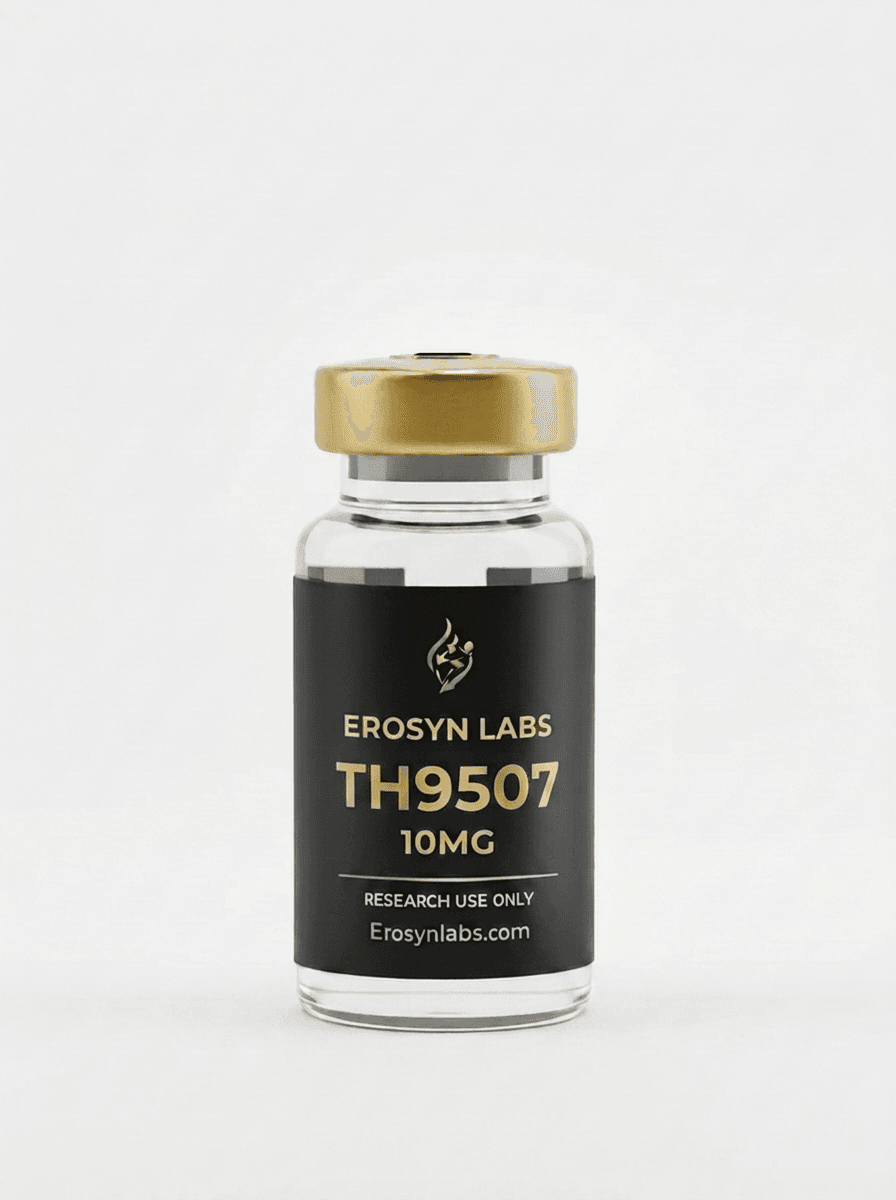
TH9507 is a synthetic analog of human growth hormone-releasing hormone (GHRH), consisting of the full 44-amino acid sequence of GHRH(1-44) with an N-terminal trans-3-hexenoic acid modification. This lipophilic modification enhances metabolic stability against enzymatic degradation while preserving full GHRHR agonist activity. TH9507 has a molecular weight of approximately 5,135.9 Da and represents one of the longest and most structurally complete GHRH analogs available for somatotroph axis research.
In pituitary somatotroph cell cultures, TH9507 activates the GHRH receptor (GHRHR) through the canonical Gs/adenylyl cyclase/cAMP/PKA signaling pathway with potency comparable to native GHRH(1-44). The trans-3-hexenoic acid modification at the N-terminus provides resistance to aminopeptidase-mediated degradation, the primary route of GHRH inactivation in serum-containing experimental systems. This enhanced stability allows for sustained GHRHR activation in cell culture models without requiring the albumin-binding approach employed by DAC-modified analogs.
A unique research application of TH9507 centers on lipodystrophy modeling. In adipocyte cell culture systems, GH axis activation through GHRHR stimulation has been studied for downstream effects on visceral adipocyte lipolysis, lipid droplet morphology, and adipokine secretion profiles. In vitro studies using differentiated 3T3-L1 adipocytes have investigated GH-mediated effects on hormone-sensitive lipase (HSL) activation and perilipin phosphorylation following indirect GH axis stimulation by TH9507 in co-culture systems with pituitary cells.
Hepatic research applications include investigation of GH-mediated IGF-1 production in hepatocyte models. TH9507-stimulated GH release in pituitary-hepatocyte co-culture systems has been used to study the somatotroph-hepatic axis, including JAK2/STAT5b signaling, IGF-1 gene transcription, and IGFBP expression patterns. Bone biology research has examined downstream effects of GHRHR-stimulated GH on osteoblast proliferation and differentiation markers in co-culture experimental designs.
Aging research represents an expanding application area, with senescent pituitary cell models used to investigate age-related decline in GHRHR expression, cAMP response, and GH secretory capacity. TH9507 serves as a valuable tool for comparing GHRHR responsiveness across passage-dependent and chemically induced senescence models.
Erosyn Labs provides TH9507 as a lyophilized powder at ≥98% purity by HPLC with mass spectrometry identity confirmation. A comprehensive Certificate of Analysis accompanies each lot. Reconstitution in bacteriostatic water is recommended. Store lyophilized material at -20°C. Reconstituted solutions should be maintained at 2–8°C and utilized within 21 days. Aseptic handling and single-use aliquoting are recommended.
For research and laboratory use only. Not for human consumption.